Switching Payment Processors: Termination Fees, Equipment Leases, and a No-Downtime Checklist
Switching processors does not have to mean lost sales. Check your contract for the costs that can trap you, then follow a step-by-step plan for a smooth move.
Before you switch: read your current agreement
Most of the cost of switching is set by your existing contract. Find your merchant agreement and look for these items.
| What to look for | Why it matters | |------------------|----------------| | Early termination fee | A fee, sometimes a fixed amount and sometimes based on remaining months or average fees, if you leave before the term ends. | | Term and auto-renewal | Many agreements renew automatically unless you give written notice within a set window before the end date. | | Equipment lease | Leases are often separate from the processing agreement, run for a fixed term, and may not be cancelable. | | Minimums and monthly fees | Some agreements charge monthly minimums or account fees that continue until closure. | | Other closing fees | Look for account closure, deconversion, or data transfer fees. |
This is general information, not legal advice. If a termination amount is large, consider having a professional review the agreement.
Equipment: own it, lease it, or replace it
- If you own your terminals, check whether the new processor can reprogram them. Some terminals are locked to a specific processor.
- If you lease, find the remaining payments and whether there is a buyout. Compare the buyout against the cost of replacement equipment.
- If you use a gateway or POS software, check whether it works with the new processor, or whether you would need to change that as well.
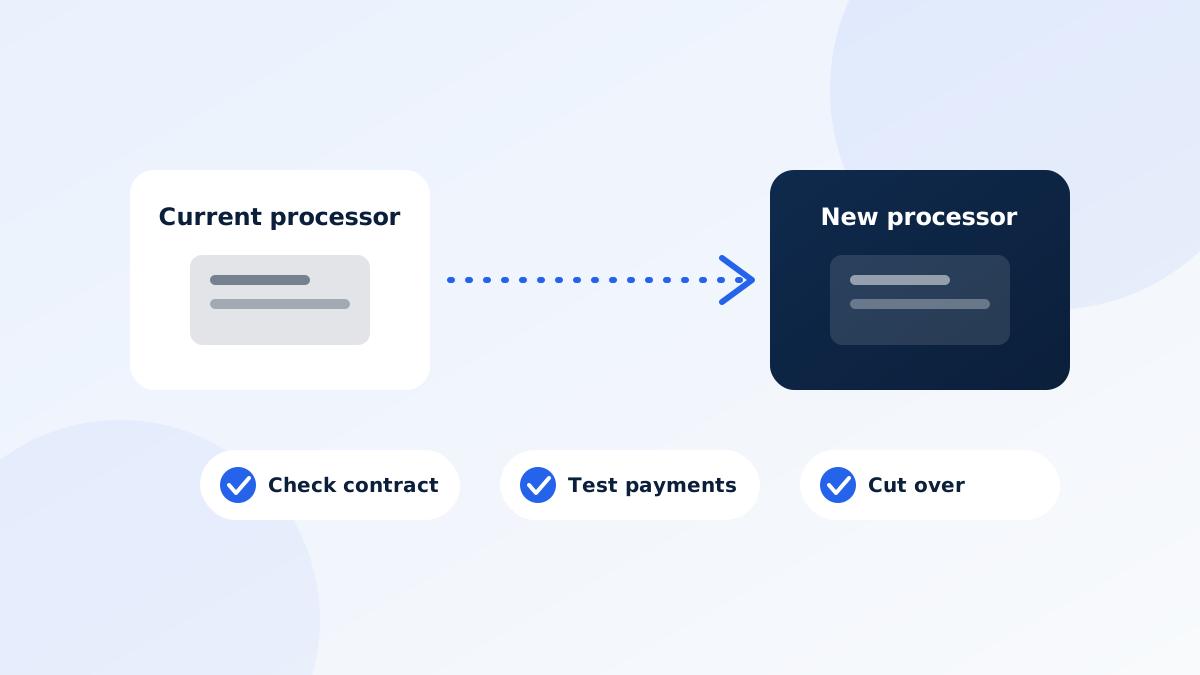
The no-downtime checklist
- Get a statement review. Send recent statements to the new processor and ask for a written estimate of your effective rate. Our free statement review does this.
- Confirm the costs of leaving. Add up termination fees, lease payments, and any closing fees, then compare against projected savings over 12 months.
- Check your notice window. If you are near the end of a term, you may avoid fees by timing the switch.
- Get the new account approved and tested. Run test transactions before you move live sales.
- Plan card-on-file data. If you store customer cards for recurring billing, ask both processors how tokens can be moved securely. Do not email card numbers.
- Update connected systems. Point your POS, online checkout, invoicing, and virtual terminal to the new account.
- Run both in parallel briefly. Keep the old account open until the first deposits from the new one arrive.
- Switch during a slow period. Choose an off-hour or low-traffic day for the cutover.
- Close the old account in writing. Request confirmation, and keep a copy. Watch for any final statements and fees.
- Review your first statement. Check that the markup matches what you were quoted.
When switching makes sense
Switching usually makes sense when your estimated savings over the remaining term clearly exceed the cost of leaving, or when your contract is near renewal. If it is not clear, a statement review will show the numbers.
Ready to compare? Request a free statement review or talk to a specialist. See also our guide to choosing a payment processor.